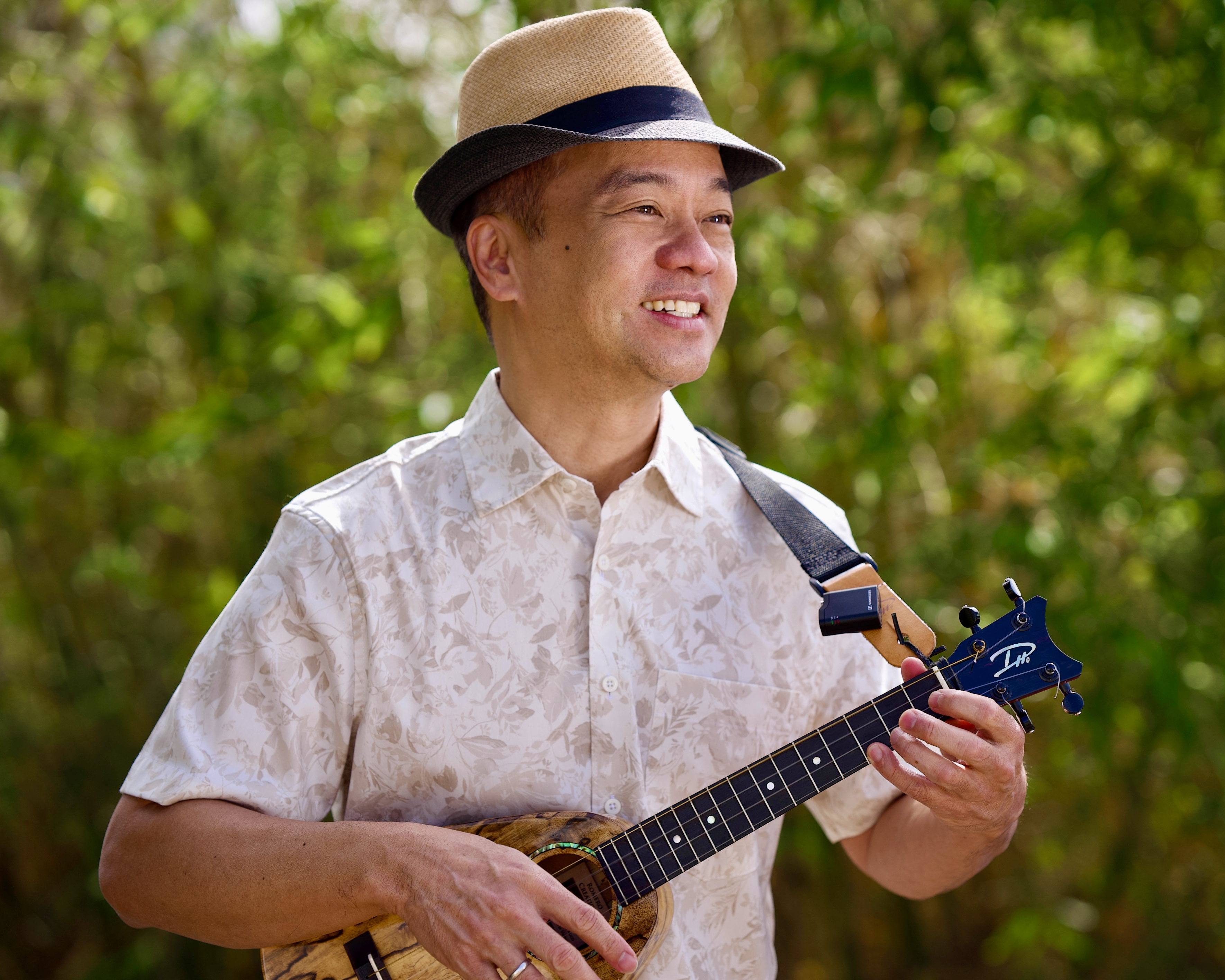
Few artists move as effortlessly across musical borders as Daniel Ho. Widely associated with the ukulele and Hawaiian music, he's spent decades carving a path far broader than any single genre (or instrument) can contain. His work spans contemporary jazz, world music collaborations, music education, and instrument design. His prolific solo catalog also continues to evolve with every project. Yet no matter where his creativity takes him, his joyful disposition and adventurous spirit remain unmistakable.
Ho's independent business approach plays a pivotal role in his artistic freedom. After an early run leading a charting contemporary jazz group in the '90s, he stepped away from the traditional label system and built a home-studio-driven, self-sustaining career long before it became the norm.
Musically, Ho's approach blends a schooled precision with an open-hearted respect for culture, craft, and sound. Whether he's engineering his own recordings, shaping a new instrument with master luthier Pepe Romero Jr., or creating video content with tools like the Sennheiser Profile Wireless, Ho brings an intentional clarity to everything he touches.
That same clarity shines in conversation as he reflects on creativity, his tools of the trade, and the pursuit of authentic expression.
Your music and instrumental ability encompass so many genres. How do you maintain your signature voice while still being so versatile?
Daniel Ho: Studying film scoring at the Grove School of Music gave me the ability to evaluate genre styles. And growing up, I had a mentor who saw some potential in me. He said, "Versatility is super important to continue working in your field." He said the best way to use this generalist approach is to write more knowledgeably about each instrument if you play it. I played drums in the marching band, bass in the jazz band, and piano. That's the foundation of where I come from.
You really got your professional start in the early '90s when you were signed by a record label. Still, you've stayed relatively independent since then. Why make that change?
The only reason was necessity. My first record deal was from 1990 to '95 in contemporary jazz, leading a band called Kilauea, which saw some middle-of-the-road success. It was just five years of writing in that genre. You end up stuck in the confines of what defines the genre.
From that period of my life, I had enough Billboard, R&R, and Gavin charts to start my own label. And having your own record company allowed you the freedom to play and work in different genres.
So I got two ADATs, I put them together, and I got 16 tracks of digital recording at home. I started making my own stuff and recording it at home. Technology allowed me to save tens of thousands of dollars on each record. And this was in the mid-90s.
I also bought
danielho.com, so my record company had a direct connection to my audience. I just started learning how to make a lousy website. I got a book with a CD-ROM that taught me Photoshop. And then I got a cheap digital camera, and I started taking album covers. I recorded a solo instrumental album and started touring internationally.
Professionally, that allowed me to work on Hawaiian slack-key guitar. Then ukulele became popular, and I started playing it, which ended up being the instrument people associate most with me. It's taken me around the world.
Speaking of around the world, your work with different groups across many cultures, countries, and vastly different styles is astounding. How do you approach these experiences?
The prerequisite for doing that is to have enough understanding and ability that the musicians won't need to simplify their music to collaborate with you. The second thing is, in respect of indigenous culture and music, I generally record what they do first, and then I add things to it.
I've heard indigenous musicians tell me that people would record them singing or something and then put it on their dance music track. So they'd have this Aboriginal melody sung in the background. That's not the way that I present their culture. I think they appreciate the fact that it can be more accessible to Western audiences, but their music remains untouched.
You said, people have pigeonholed you with the ukulele. Is that the instrument you default to on these projects?
My three main instruments are piano, guitar, and ukulele. Whatever the song requires is what I'll play. So, if it's a song, like "Gray Sparrow's Heartache" on the Between the Sky and Prairie album, which is a Mongolian song with long chords, I played piano because I needed the sustain. But if it's a fast, happy drinking song, I'll do it on a ukulele.